
British Army Tattoo Policy (2026)
Thinking about getting tattooed before enlisting? Or do you already have tattoos and wondering if they'll hold you back? Here is exactly what the British Army Tattoo Policy 2026 says:
British Army Tattoo Policy 2026: Quick Answer
Can you join the British Army if you have tattoos?
Yes, most tattoos are fine. The rules focus on where your tattoos are and what they depict, not simply whether you have them.
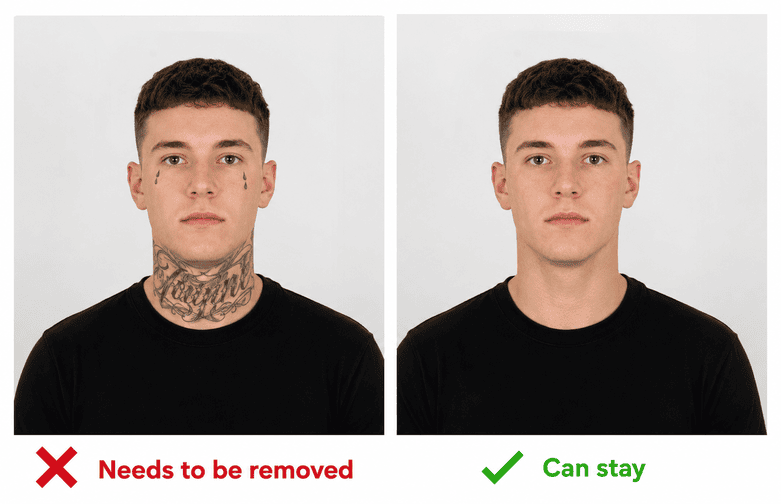
- Face & throat tattoos: Not permitted. They fail the passport photo test.
- Hand & back-of-neck tattoos: Allowed since 2014.
- Sleeve & body tattoos: Permitted if content is not offensive or obscene.
- The passport photo test: If your tattoo shows on your face, front of neck, or ears in a standard passport photo, it is a bar to entry.
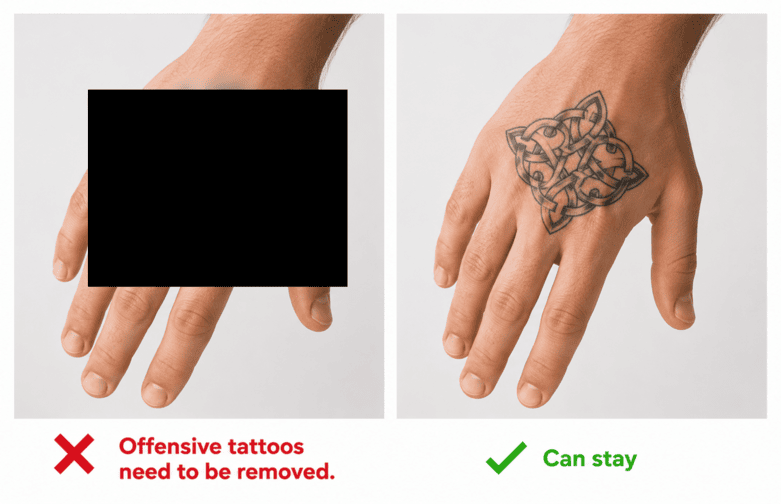
- Offensive content: Never acceptable, regardless of location.
Tattoo Removal, London
Need a tattoo removed before you enlist? We do fixed-price removals.
Some people have a tattoo that falls inside the restricted areas and need it removed to meet the Army's requirements. Others simply want a clean slate before a new chapter, whether or not the Army is the reason. Either way, we can help.
We specialise in laser tattoo removal and our approach is straightforward: we look at your tattoo and give you a single flat fee to remove it completely. No per-session billing, no estimate ranges, no guessing how many treatments it takes. One price, all the way gone.
Hand Tattoos & the British Army
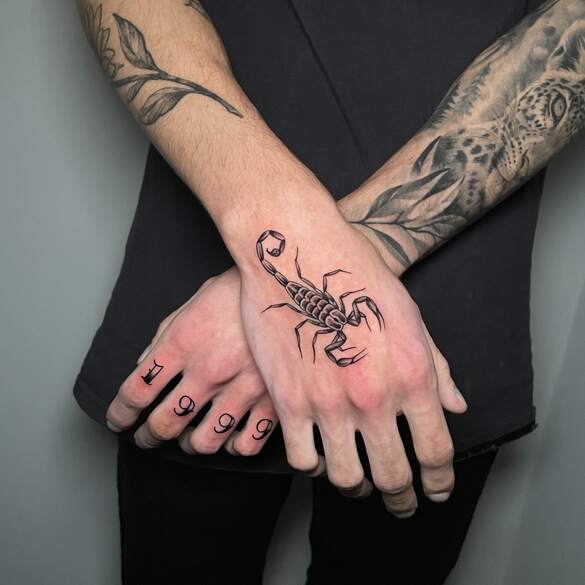
Hand tattoos are now allowed in the British Army. Prior to 2014, any visible hand tattoo was an automatic bar to entry. That rule was removed and hand tattoos are now assessed on content, not location.
Are hand tattoos allowed in 2026?
Yes. As one serving soldier confirmed: "It used to be you can't have hand tattoos, but they've now opened up that you are allowed." The blanket ban has been removed.
Is there anything to watch out for?
One exception: AGAI 59.08(d) notes that a message on the palm of the hand visible when saluting could still be rejected at the commanding officer's discretion. Beyond that, content is what matters. Location alone is not the test.
There is also an informal tradition of keeping the saluting (right) hand free of tattoos as a mark of respect. It is not a formal rule, but some recruiters may raise it.
What about finger tattoos?
Finger tattoos fall under the same rules as hand tattoos: permitted, subject to content. The 2014 change that lifted the hand ban applies here too.
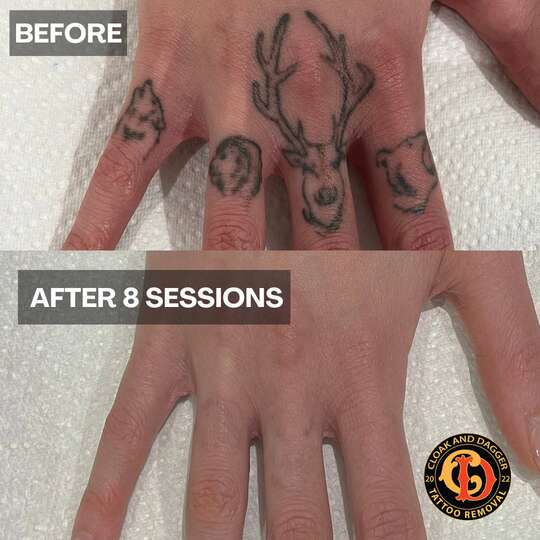
What if my hand tattoo is a problem?
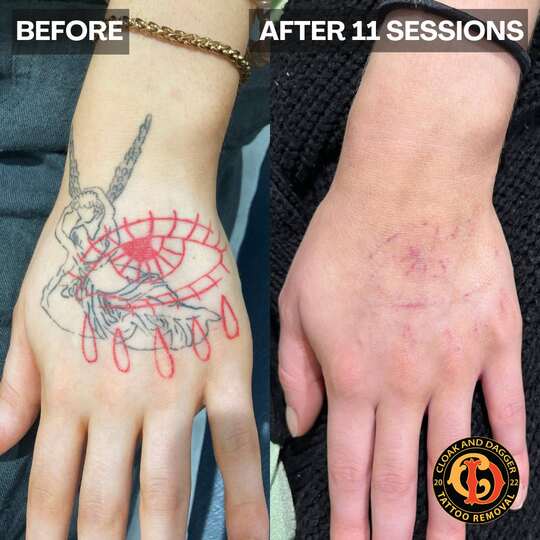
If your tattoo is on the palm, or contains offensive content, removal may be required. We offer fixed-price hand and finger tattoo removal. Get a quote here.
Neck & Throat Tattoos and the British Army
This is the most important distinction in the entire policy. The Army does not ban all neck tattoos. It bans tattoos visible on a passport photo. Where your neck tattoo sits determines everything.
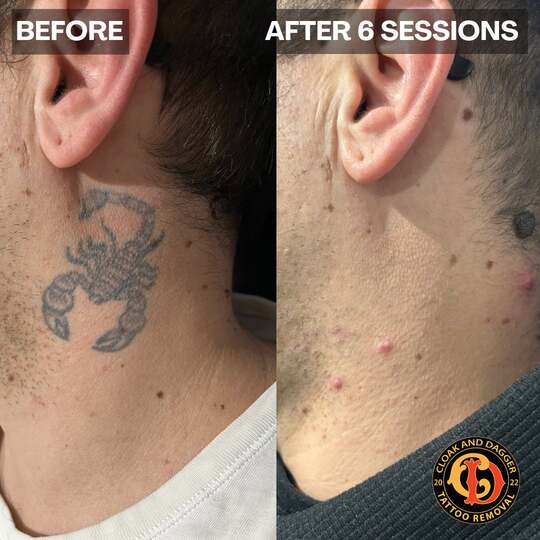
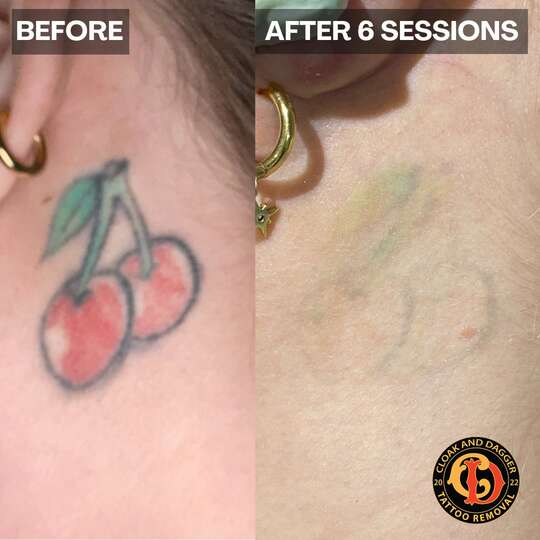
Can you join the British Army with a neck tattoo?
It depends on where it sits. The regulation draws a boundary from the bottom of the ear to the collarbone. Tattoos forward of that line, visible on the front of the neck in a passport photo, are not permitted. Tattoos on the back of the neck are fine.
What about throat tattoos?
Throat tattoos almost always fail the passport photo test. If your tattoo is visible on the front of your neck, throat, or jaw in a standard passport photo, it is a bar to entry under AGAI 59.08(a). This is one of the most common reasons people seek tattoo removal before enlisting.
How do I know if my neck tattoo is a problem?
Take a passport-style photo of yourself in a shirt with one button undone. If your tattoo is visible in that photo, even partially, it is likely to be flagged. If it is not visible, you are almost certainly clear on location grounds.
I have a throat or front-neck tattoo and want to enlist. What can I do?
Removal is the route most people take. We specialise in neck and throat tattoo removal and understand exactly which areas the Army tests. We will give you a fixed flat-fee quote to remove it completely. Enquire here.
Sleeve Tattoos & the British Army
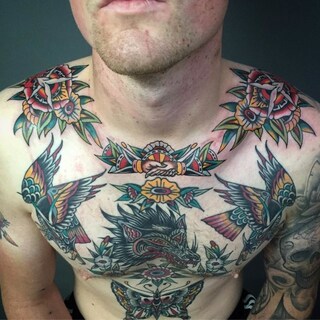
Full sleeve tattoos are permitted in the British Army, provided they do not extend into banned areas (face, front of neck) and do not contain offensive content. A full arm sleeve is not a bar to enlistment.
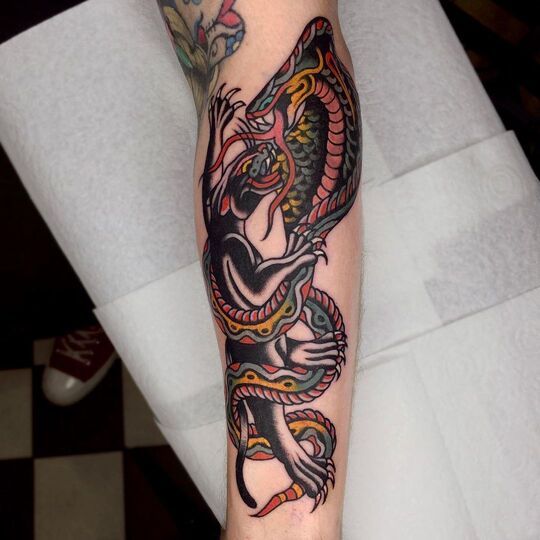
Can you join the British Army with a full sleeve?
Yes. Arm sleeves are not banned. The rules target specific locations (face, front of neck) and specific content (obscene, offensive). A sleeve that stays below the collar and does not contain prohibited imagery will clear the process without issue.
What if part of my sleeve extends up the neck?
If it extends onto the front of the neck or throat and is visible in a passport photo, that portion is the problem, not the rest of the sleeve. In some cases, partial removal of the upper throat section of a sleeve is all that is needed.
Will I need to submit photos of my sleeve during my application?
Yes. The tattoo proforma requires photos of all tattoos. A sleeve will be reviewed, but the review is about content and location. Not the size of the tattoo. Most sleeve tattoos pass without issue.
What if my sleeve has offensive imagery that needs to come out?
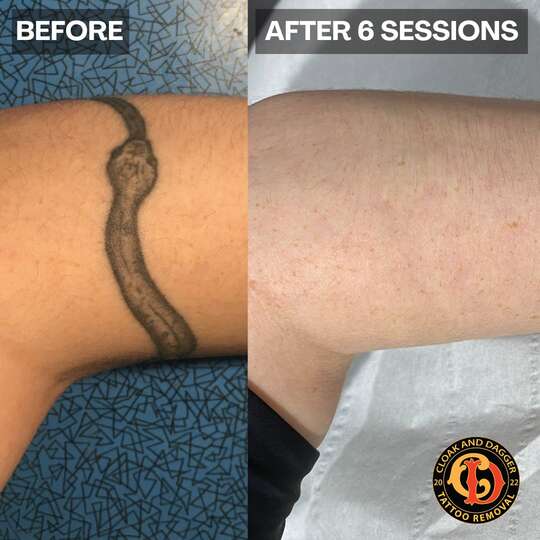
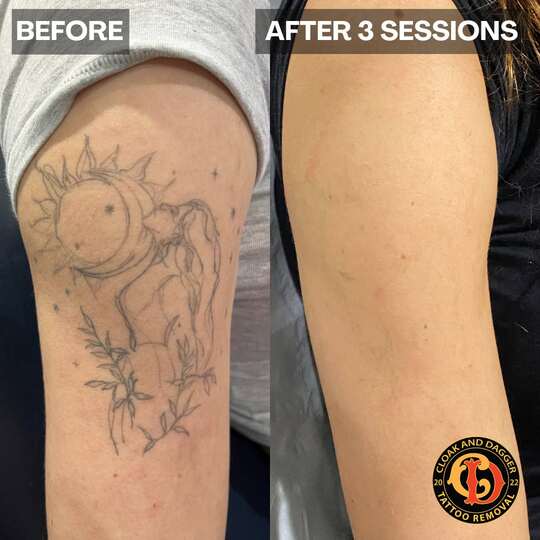
We can remove part or all of a sleeve. Whether it is a specific panel with problematic content or the entire piece, our fixed-price model gives you certainty on cost from day one. Get a quote.
Hear It From a Serving Soldier
The rules above come from the official regulation, but it is also worth hearing how serving soldiers describe the policy in their own words. This short clip covers the key points in under two minutes.
Key Moments
Click any timestamp to jump to that moment.
- ► 0:00 — "Can you join with tattoos? Yes. However, you can't have face tattoos."
- ► 0:07 — "It used to be you can't have hand tattoos, but they've now opened up that you are allowed."
- ► 0:13 — "As long as you get a passport photo and you can't see your tattoos in that, you're fine."
- ► 0:25 — "If you've got tattoos, you'll have to send photos in anyway and it'll get cleared by a team."
- ► 1:05 — "We're pretty relaxed and in line with the rest of the civilian world as well."
British Army Tattoo Policy 2026: The Official Rules
The rules below come directly from the British Army's official guidance. The Army's position as of 2026 is that tattoos are broadly acceptable. The focus is on where they are and what they depict, not on whether you have them at all.
Quick Reference: British Army Tattoo Rules
- The general rule: if your tattoo is visible on a passport photo, it will be deemed unacceptable.
- Offensive or obscene tattoos (depicting sex acts, violence, or illegal drugs) are not allowed, regardless of where they are on your body.
- Hand tattoos and back-of-neck tattoos are now permitted. Most soldiers keep their saluting hand clean out of respect, but it is not a formal rule.
- Face and head tattoos are not acceptable. This applies to both new applicants and serving personnel.
- If you're unsure, visit your nearest Army Careers Centre and show them in person. Don't wait until later in the process.
What the Official Regulation Says (AGAI Vol 2, Chapter 59)
The following is the exact wording from the Army General Administrative Instructions (AGAI), Volume 2, Chapter 59: Dress and Personal Appearance (August 2021). This is the regulation that Army recruiters and commanding officers apply when assessing tattoos.
59.08. Tattoos and Piercings. It is Army policy that a person with tattoo marks which, because of size, position or nature, are unacceptable and detrimental to the Service is ineligible for enlistment, re-enlistment or continued service in the Army. [...] Unacceptable tattoos are defined as being any tattoo mark which meets one or more of the criteria listed below:
a. Visible. Visible on a front view passport photograph taken whilst the subject is wearing an open necked shirt with one button undone; that is on the face or throat area, on the front of the ear or forward of a line from the bottom of the ear to the collar bone.
b. Obscene. Irrespective of its size or position on the body, a tattoo will be obscene if it refers to or depicts an image of: a sexual act; extreme pornographic behaviour; sexual violence; extreme violence; violence to or sexual activity with a child or animal; or illegal drugs.
c. Offensive. Irrespective of its size or position on the body, a tattoo will be offensive if, by its nature it has the purpose or effect of violating another person's dignity or creating an adverse environment for others (for instance because it refers to or depicts an image relating to a protected characteristic of gender, sexual orientation, race, religion, disability or age).
d. Any tattoo mark which does not meet one or more of the criteria above but which, in the opinion of the individual's CO or a recruiting officer, is nevertheless, by virtue of its size, position or nature, unacceptable and detrimental to the Service — for example, a message on the palm of the hand which would be seen when saluting.
AGAI Vol 2, Ch 59: Dress and Personal Appearance, August 2021 (AEL 139, AC 60974/2)
An updated edition of AGAI 59 was published in May 2024. The document is held within the MoD's Defence Gateway. Serving personnel and those with access can view it at: Defence Gateway: AGAI 59 (May 2024 update). A written parliamentary question on tattoo policy was also answered in July 2025: Parliament.uk: Written Question 65751.
History of British Army Tattoo Policy Changes
The British Army's tattoo rules have not always looked the way they do today. Understanding how the policy evolved, and what forced it to change, helps explain why the current rules are drawn where they are.
Before 2014: The Old Rule
For most of the Army's modern history the rule was simple and strict: tattoos had to be hidden by a shirt. That meant nothing visible below the collar or above the cuff. Any tattoo on the hands, wrists, neck or face was an automatic bar to entry, regardless of what it depicted.
June 2014: A Freedom of Information Request Reveals the Scale of Rejection
In June 2014, a member of the public submitted a Freedom of Information request to the Ministry of Defence asking a direct question: "How many prospective servicemen and women have had their applications rejected because of unsuitable tattoos be it offensive or inappropriately placed? Please list the figures per year for the last five financial years."
The MoD's response, issued in July 2014, revealed a striking picture. Army rejections for tattoos had held steady at around 24–25 per year from 2009 to 2013, but in 2013/14 the figure jumped to 336.
| Year | 2009/10 | 2010/11 | 2011/12 | 2012/13 | 2013/14 |
|---|---|---|---|---|---|
| Army rejections | 3 | 25 | 24 | 25 | 336 |
The MoD itself acknowledged the spike was unusual and offered two explanations: a new and more detailed reporting system had been introduced, and, crucially, prior to the online application process, recruiters at Armed Forces Career Offices had often screened out tattooed candidates informally in person, meaning those cases never reached the recorded application stage. The online system removed that informal filter, and the numbers made it into the data for the first time.
The same FOI response noted that the MoD was "about to undertake a review of tattoo and piercing policy." That review would produce results just three months later.
October 2014: The Army Eases Its Rules
On 2 October 2014, the BBC reported that the Army had officially relaxed its tattoo policy. Hand tattoos and tattoos on the back of the neck were now permitted. The face remained off-limits, as did any part of the neck visible in a passport photo. The old blanket ban on anything above the cuff or below the collar was gone.
The change had been driven in part by Capita, the private company then running Army recruitment. Capita's Chief Operating Officer, Dawn Marriott-Sims, had told MPs that the old rules were "a barrier to a significant number of our target population."
The context mattered too. The Army was in the middle of a significant restructuring, reducing from 102,000 regular soldiers to 82,000, while simultaneously trying to boost its reserve force from 19,000 to 30,000. With one in five Britons now estimated to have a tattoo, maintaining strict visible-tattoo rules was costing the Army a meaningful proportion of potential recruits at a time when numbers were under pressure.
MoD spokesperson statement, October 2014: "Tattoos have become more acceptable in society over the last decade and, in recent years, there has been an increasing number of personnel with tattoos on visible areas. Visible tattoos have no adverse impact on operational effectiveness."
The US Army had made the same move, allowing hand and neck tattoos, back in 2006, so Britain's change came eight years after its closest ally had already updated its position.
February 2024: Over 800 Recruits Rejected Despite Ongoing Hiring Crisis
A decade after the 2014 relaxation, the problem had not gone away. In February 2024, The Sun reported that more than 800 potential Army recruits had been prevented from joining because of their tattoos in the preceding period, with a further 400 rejected over piercings. Together those numbers would have filled the ranks of a brigade.
The figures landed at a difficult moment. The Army was facing a shortfall of 12,000 recruits since 2018, yet had turned away 126,000 applicants over the same period for all reasons. Tattoos and piercings alone were accounting for over 1,200 of those rejections.
The boss of Capita, the company running Army recruitment, had already been urging the Army to ease its medical and appearance rules, arguing they were shutting out otherwise-qualified candidates at a time when the services could not afford to be selective.
The report was a direct echo of the 2014 pattern: data revealing large-scale rejection, a recruitment shortfall providing political pressure, and Capita pushing for further relaxation. That pressure fed directly into the updated policy framework published later in 2024.
2021 and Beyond: AGAI 59 and the Current Framework
The 2014 relaxation was formalised and refined in the 2021 edition of AGAI Volume 2, Chapter 59, the regulation that governs the current policy. That document set out the detailed rules still in force today, including the proforma assessment process, the passport photo test for neck and face tattoos, and the specific guidance on location, content and size. The 2024 update to that policy further refined the framework. The current rules are therefore the product of a decade of incremental reform, pushed along by FOI data, recruitment pressure, and a recognition that British society had simply moved on.
What to Do If You're Unsure Whether Your Tattoo Is Acceptable
If you have a tattoo and you're not certain whether it meets the Army's criteria, don't guess. Get it checked early. Unresolved tattoo queries are one of the most common causes of unnecessary delays in the application process.
How to Get Your Tattoo Checked
- Visit a local Army Careers Centre. You can walk in and show your tattoo to a recruiter in person. They will assess it against current policy and advise whether it needs to go to a senior officer for clearance.
- Use the online application portal. If you apply online, you will be asked to complete a tattoo proforma and upload photos. This is the standard route for most applicants and the clearance team works through these routinely.
- Apply the passport photo test yourself. If the tattoo is visible on your face, front of your neck, or head in a standard passport photo, it is likely to be a bar to entry. If it is not visible in that photo, you are almost certainly fine on location grounds.
- Call the National Recruitment Centre: 0345 600 8080. If you cannot visit in person, call for guidance before your application progresses further.
This guidance is consistent with the Army's official tattoo and piercings page and reflects the position set out in AGAI Vol 2, Chapter 59, as well as guidance published by the Army's recruitment team in early 2026.